











































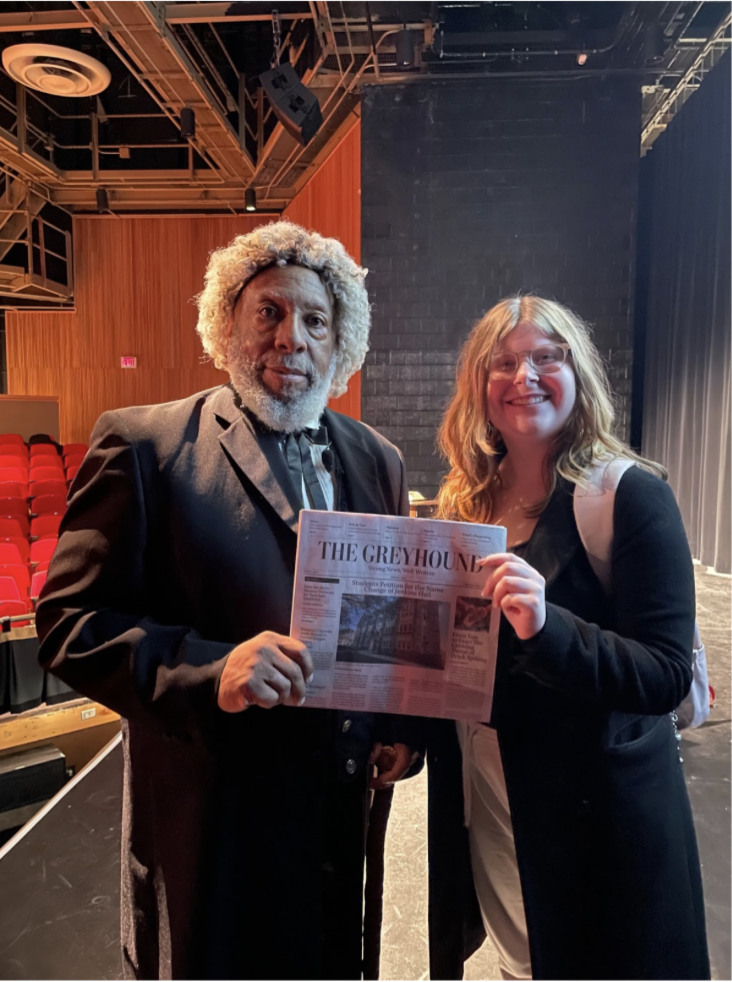
Last Wednesday, McManus Theatre housed students and faculty as they were taken back to the time of Fredrick Douglass. During this hour, reenactor Nathan Richardson, currently in his 14th year of the Fredrick Douclass speaking tour, shared both the struggles and successes that historical figure Fredrick Douglass endured throughout his lifetime.
The stage was set with the backdrop of a typical 1800s-style home. This included yellow wallpaper, a dark marble fireplace, candles, and satin chairs. These accompaniments helped to guide participants as they sat and heard of the retelling of the life of Douglass, starting from the very beginning when he was enslaved in Talbot County, on the Eastern Shore of Maryland.
Already beginning his Douglass impersonation, Richardson came on stage and said that Loyola requested he speak to the audience about American Democracy.
“We thought the principle of free speech was an accomplished fact. Here, if nowhere else, we thought, the right of people to assemble and to express their opinion was secure,” Richardson said.
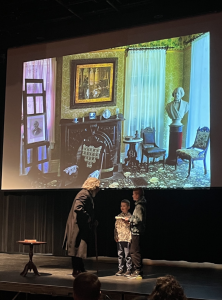
Richardson acknowledged that the leaders of the law were ‘gentlemen,’ stating that they were men who prided themselves on their respect, the law, and order.
“These gentlemen brought with them their respectful law, and loudly proclaimed it, while in the very act of breaking the law,” Richardson said.
In character, Richardson recounted how in the relatively early stages of Douglass’s life, he was taught by his owner’s wife the ABCs, as well as words from the Bible and the newspaper. Once her husband found out what she was doing, he forbade it from continuing. It was from this point on that Douglass was left to his own devices.
Shortly after this introduction, the reenactor had two young boys come on stage and read an excerpt from The Columbian Order, where he shared Douglass’s sentiment that once you can read, you will be forever free.
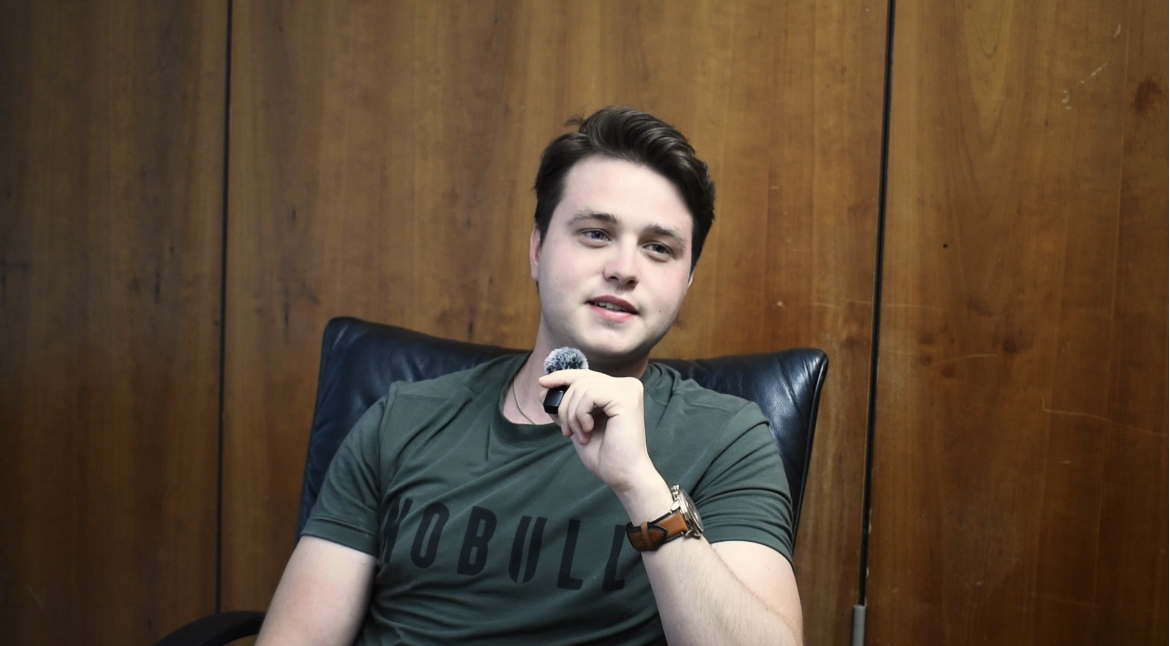
Associate Professor and Director of the Humanities Symposium Billy Friebele shared what he thought of the event and commented on the nature of Richardson’s performance.
“I thought the event was a great way for students to experience the text firsthand. Nathan Richardson engaged the audience in a lively performance, and a highlight was when he asked the children in the audience to join him on stage to read a poem,” Friebele said.
Friebele also commented on his appreciation for the way Richardson stayed in character as he answered questions from the audience at the end of his performance.
“He did so with humor and improvisation, while weaving parts of Douglass’ speeches into his responses. The questions from the audience were great and showed that they were really engaged in the performance,” said Friebele.
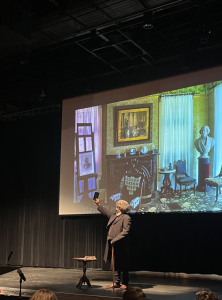
Students also felt that the event was an opportunity for them to expand their knowledge on the legacy of Douglass. Many students shared that they remember learning about the historical figure and abolitionist in the past, but can only recount a few details.
Declan Ames ‘29 shared what excited him most about the event and how his major played a role in his attendance.
“As a history major, I’m always looking forward to learning more stuff that can enhance my studies, so this seemed to be a good opportunity. I’ve learned about him in the past few years, so it will be nice to get a refresher on it and it just seemed like an opportunity to learn more,” Ames said.
To learn more information about registration and upcoming events,as well as the upcoming Humanities Symposium: Life, Liberty, and the Unfinished Work of Democracy, you can visit The Bridge.