
































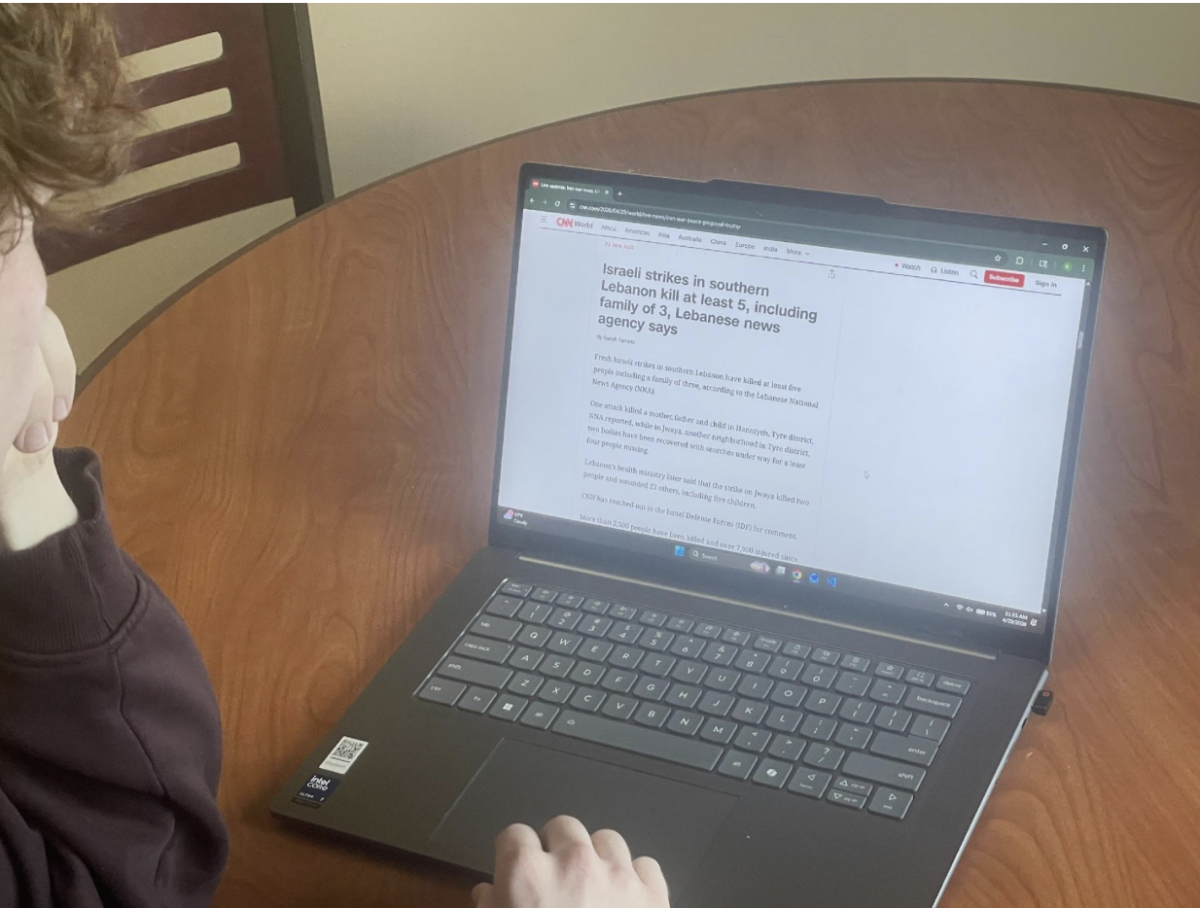









































It goes without saying that we’re living in the most chaotic, confusing, overwhelming, and uncertain period of American history of our lives so far. The truth is that these events may end up changing our lives in their entirety.
The nature of the period we’re living in is self-evident, but that fact only makes many of us feel more compelled to turn our eyes and ears away from what’s happening. Whether that is because it’s unpleasant, or it doesn’t really concern us, or we don’t have any power over these large-scale matters. Following these developments doesn’t make a difference in our minds. However, the truth is that unpleasantness is no justification for turning away, and that what’s happening in the world does concern us and is not beyond our reach.
For something unpleasant to become pleasant, or at least less unpleasant, action needs to be taken. Nothing can be done by people who won’t face the unpleasant in the first place.
When this period is over, the ones who will simultaneously have direct opportunity to take that action while also being at the most risk if action isn’t taken will be our generation. We have sway in our world, as well as the capacity and responsibility to change things with that power.
A friend of mine put me onto this quote by Alice Walker: ‘The most common way people give up their power is by thinking they don’t have any.’
It is important to face the unpleasantness with your eyes and ears open, no matter what.
The First Hour of the War
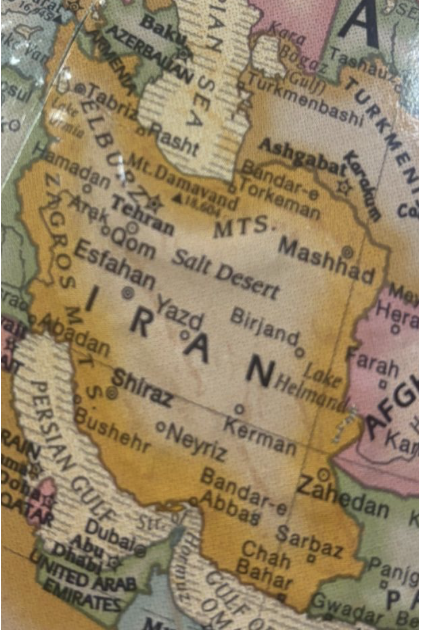
On February 28th, the U.S. announced the beginning of a military operation, in coordination with Israel, against Iran. Within ten minutes of President Trump’s message being posted, the Israeli Air Force launched, what they call, ‘pre-emptive attacks’ against the leadership of Iran.The U.S.’s partnership with Israel gives unique context for why this conflict began when and how it did.
Assistant Teaching Professor of history Dr. Bahar Jalali goes over the fragility of the previous ‘peace’ between the US and Iran and how it was disturbed.
“While the Obama administration made efforts to neutralize these tensions through diplomacy, we are now seeing a return to a more confrontational past. It is clear that Israel has sought a military confrontation with Iran for a long time, and the current U.S. administration has effectively blessed that path,” Jalali said.
Israel’s first barrage was successful in killing Iran’s Supreme Leader Ali Khamenei, as well as other important leadership. Approximately thirty minutes later, the U.S. carried out a highly controversial strike on the Shajareh Tayyebeh elementary school in the Iranian city of Minab, killing 180 people, mostly school girls.
The Nature of the War
This war is a disgustingly illegal and confusing yet blatant and destructive power grab meant to further extort and impoverish the attacking and attacked nations’ peoples in the form of a war begun on the pretense of preventing a future war that was never coming.
It is difficult to even put into words the complexity of the conflict. Additionally, this war is further contextualized by the fact that it’s the latest chapter in the over 70 years history of the U.S.’s cruel meddling in Iran. On top of that, some speculate this war also serves as a distraction from the Epstein Files.
The Legality of the War
This war is illegal. Trump began this war without the proper notification of Congress as required by the 1973 War Powers Resolution. Though Congress has failed to check Trump, effectively greenlighting the war’s continuation, the violation was still committed.
Additionally, America and Israel began this war with a ‘crime of aggression’ or ‘crime against peace.’ Therefore, the act could be considered a war crime per international law.
The Ambiguity of the War
When news of the war against Iran broke out, Trump’s first official statement laid out one clear goal and one unclear one. He began his announcement by stating that the objective of the operation was to stop threats posed by Iran for the sake of the American people. These threats, he would go on to clarify, were related to nuclear weapons.
According to Trump, Iran was warned time and time again to cease nuclear ambitions, but they were just so stuck on continuing that their country had to be devastated as a consequence.
This questionable motive aside, it wouldn’t be the only one expressed. Eventually, Trump would suggest in his announcement that there was another motive at play: regime change.
Even though the messaging is clear, members of our government weren’t able to agree on the idea that this was even a war for weeks.
The Political and Economic Polarization of the War
This war is a power grab. Israeli Prime Minister Benjamin Netanyahu has said since the beginning that goal is regime change, and Trump eventually expressed a clear desire to replace the dead Supreme Leader of Iran with a candidate more suitable in his eyes.
It should be noted that regime change has quite an abysmal reputation throughout history, especially when the U.S. is involved.
Jalali gives a historical example of this that also contextualizes tensions between the US and Iran.
“In the early 20th century, there was much goodwill in Iran toward America as a counterweight to Britain and Russia. However, in 1953, the U.S. and the U.K. overthrew a democratically elected leader and replaced him with a dictatorial monarch, the Shah. The U.S. then helped the Shah create a notorious secret police, SAVAK, that brutalized dissidents. The 1979 Iranian Revolution was, in many ways, a nationalist response to this history of foreign aggression,” Jalali said.
The US has historically gone into Iran and left it a far more dangerous and less stable place. So, is the goal here to liberate an oppressed people, or is it just to continue this destructive cycle?
It must also be mentioned that when crime becomes the norm for these leaders, they freely take whatever they want from these lands. This gets much more significant when the nation being illegally invaded is the third to fourth most oil-rich country in the world.
Does all of this sound familiar? Venezuela had to suffer a very similar series of attacks and destabilization earlier this year. However, instead of the U.S. blatantly seizing oil like in Venezuela, Iranian oil facilities are being relentlessly bombarded by the U.S. Trump said he would love to take Iran’s oil, too, if he could have things his way.
These attacks, in combination with Iran attacking the Strait of Hormuz, have not only restricted oil flow but also skyrocketed oil prices. As of April 18th, oil costs are up 30%. This war’s financial consequences extort not only the Iranian people but all people not at the top, American and Israeli citizens included.
Oil prices being so high takes money directly from ordinary citizens and puts it in the pockets of those at the top, especially the U.S. government with its stolen oil assets. War pays those at the top in other ways, too, namely via the Military Industrial Complex, the system of American weapon contractors and government officials whose business is weapons dealing.
When war has high monetary potential, instead of a last-ditch effort of defense, it becomes a financial strategy.
The Lies of the War
This war began on a lie. Circling back to Trump’s first announcement, the two justifications he gave for the war were to stop the development of nuclear weapons and free the people of Iran. With the regime change topic already analyzed, let’s quickly unpack the former lie.
Historically and currently, the truth is self-presenting. Simply look at how Netanyahu has been claiming Iran has been months away from a nuclear weapon for 33 years, but no evidence of the completed bombs has ever been found.
To add to how pathetic this fact becoming clear made these governments look, the lack of bombs was revealed around the time the U.S. government got their story straight and the justification for this war shifted to ‘Trump had a feeling Iran would attack first.’
The nuclear power claim was a lie, but the oldest lie is that our conflict with Iran is some ancient, fundamental, and unchangeable conflict. Demonizing Iran so any conflict with them doesn’t need any actual justification is extremely dangerous and part of what allows conflicts like this to be even partially valid in the minds of many people.
It’s choices that create these conflicts, not some axiom. And when all of the manipulative narratives like that are peeled back and you’re able to see the unobscured truths, eventually you have to ask yourself who the terrorist nation really is.
The Collateral of the War
In the first two weeks after the war, almost 20 countries are now involved in some way, and well over 5,000 people are dead and over 24,000 injured. This is the reality of this war, a war Trump made sure to brag he dragged Israel into rather than it being the other way around.
Is that completely true, though? While Israel functioning as the US’s war proxy does effectively make them a U.S. tool, the symbiotic relationship is mutually beneficial, as either side can get the other to bend if they so desire.
This idea was touched on in the statement given by Jalali and reaffirmed by Visiting Assistant Teaching Professor of history Dr. Janna Haider.
Haider echoed words Jalali shared during the Mar. 17 Iran Teach-In, sponsored by Loyola’s Departments of History and Political Science, Global Studies Program, and Office of Peace and Justice.
“As professor Jalali said, it seems that in a lot of ways the US has outsourced its foreign policy to Israel, and there’s no reason other than the U.S.’s alliance with Israel for this to be happening. And it’s disappointing to see a country that calls itself the most powerful nation in the world take direction from somebody else,” Haider said.
This a complex, global war with layers of historical context co-lead by an incompetent psychopath who would casually threaten a genocide of unprecedented scale when negotiations don’t go his way just to take it back less than two hours before the given deadline just as casually. A man who only sets the records that should never be set, being the only convicted felon president for one. A man mentioned more times in the Epstein Files than God is mentioned in the English Standard version of the Bible.