









































The following represents the opinion of the student reporter and does not represent the views of Loyola University Maryland, the Greyhound, or Loyola University’s Department of Communication.
The United States did not cross its Rubicon with a single election, protest or act of violence. It crossed quietly with a scroll.
In Roman history, ‘crossing the Rubicon’ signaled an irreversible decision, a step from which there was no turning back. In today’s world, that threshold may be digital rather than geographic.
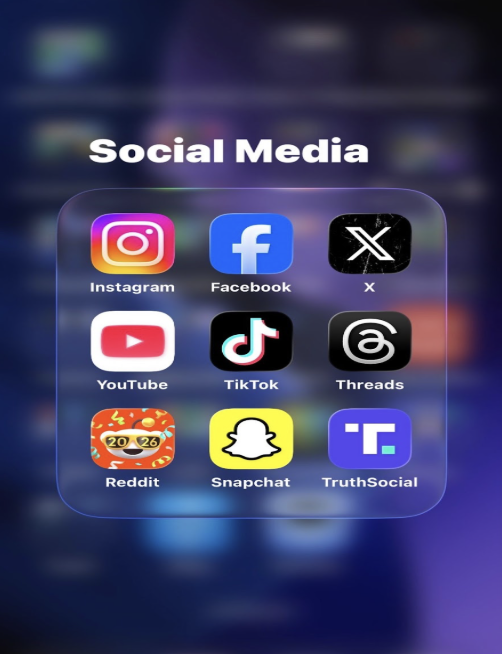
Social media was once a tool marketed as a democratizing force, a tool that would connect people across distance and difference. For today’s students, however, it decreasingly feels like a platform we use and increasingly like an environment we inhabit, one that is reshaping our mental health while simultaneously hardening political and social divisions.
On college campuses, the mental health crisis is no longer abstract. Anxiety, depression and burnout are common features of student life. While there is not a single factor that explains this trend, a growing volume of research has linked heavy social media use to negative mental health outcomes among young people. Students report feeling overwhelmed by online drama, feel the pressure to create a public identity, and feel worse about themselves after prolonged scrolling.
In too many cases, online personas give an exaggerated and inauthentic view of life, experts have said.
“You have to have the perfect filter to make your perfect face or the perfect body, because that’s what influencers are showing you,” said Dr. Sara Magee, Associate Professor of Communication and Media at Loyola.
What makes this crisis especially troubling is that it is seemingly by design. Social media platforms are built around algorithms that prioritize engagement above all else. Content that provokes strong emotional reactions such as outrage, fear and envy are rewarded with visibility.
For students, this means feeds are saturated not only with idealized lifestyles and appearances, but with relentless political conflict. Emotionally charged and false content spreads significantly faster than neutral or factual information, giving outrage an algorithmic advantage rather than a byproduct.
“In a perfect world, the social media algorithm would provide other perspectives,” Magee said
These same dynamics do not stop at mental health. They spill directly into the political sphere. Research has shown the algorithmic exposure to inflammatory and partisan content increases polarization, even amongst the users that do not actively seek it. Over time, the political identity of Americans becomes less about policy and more about emotional allegiance. Disagreements are felt as attacks and compromise is experienced as betrayal. A Pew Research Center survey found that 64% of Americans believe social media has been bad for democracy, far higher than in other advanced nations.
“Not only are incentives set up to promote content from people who are saying extreme things, but that becomes what people understand to be normative,” added Alexandra Dildine, a former adjunct professor at Loyola who taught the course Organizing America in the Digital Age.
This creates echo-chambers, which inevitably drive people deeper into this extreme rhetoric.
“They think that is what everybody else thinks so they don’t contribute their own more nuanced view as they feel there isn’t a place for it or that they’ll get attacked,” said Dildine.
America’s political parties have frankly adapted perfectly to this environment. While Democrats and Republicans disagree on policy, they share a dependence on the same messaging tactics in the digital world. They frame opponents as existential threats, dumb-down complex issues into viral slogans, and feed off emotions for higher visibility. It is not accidental, and it is not free of cost. Each escalation, driven by need for attention and clicks further erodes trust, deepens hostility, and makes democratic norms harder, if not impossible to sustain.
When political conflict is filtered through outrage and identity, it is not contained to political ideology. Social media increasingly forces users to divide the world into enemies and allies, rewarding content that assigns blame rather than seeking understanding. In that environment, racist, anti-semitic and homophobic narratives spread with ease, often framed as cultural critique or irony rather than explicit hate. The critique here is not to police humor or satire but to be directed at algorithmic incentives that privilege hateful engagement. The result is not only increased hostility towards groups but a broader dehumanization of fellow Americans.
This normalization has consequences. When social media users are repeatedly exposed to content that portrays entire groups as threats, trust erodes: in our neighbors, in friends, in institutions and democratic processes. Political opponents cease to be fellow citizens and become symbols of decay and danger. In such an environment, hostility feels justified and violence becomes much easier to rationalize, which we have repeatedly seen in recent years.
Today, students sit at the center of this transformation. We are by far the most digitally immersed generation in history, growing up in systems that influence not only how we socialize, but how we think, argue and engage with the world. Mental health struggles and civic disintegration are not separate cases, they are symptoms of the same design choices.
Disagreement is not dangerous, disagreement is the pinnacle of a free society. The danger lies in a digital environment that wires us to experience disagreement as a threat, one that rewards outrage over curiosity, treats empathy as outdated, and makes restraint optional.
This is most certainly not a call to abandon social media or to fantasize of a world without it. Social media has real benefits: community, creativity, humor, and access to information. But benefits do not always outweigh costs. Addressing this crisis requires deep structural change, not just personal restraint, but digital literacy, mental health investment and accountability from social media companies shaping public discourse.
“Everyone should become more aware and think before they post, especially when it comes to serious topics like politics and health,” Magee said.
The Rubicon has seemingly been crossed, but that does not mean that our future is fixed. If we choose to confront the incentives driving the digital age, then we can return to a society where disagreement is not a fault line but a foundation, where technology serves democracy rather than undermines it, and where algorithms do not reflect our worst impulses but our best possibilities.
Mike • Jan 21, 2026 at 8:28 pm
This is such an insightful take on an issue that has been plaguing us as a society. We’re far too divided and need to seek out disagreement so we do not fall deeper down the rabbit hole of our own biases and deeply held beliefs.
Atta chef don
A.Hale • Jan 21, 2026 at 6:22 pm
Well written, thought provoking, factual.