































































































As fall wraps up, Loyola’s campus arboretum prepares for winter before blossoming again in the spring. Since 2013, Loyola’s campus has been an accredited arboretum through the Morton Register of Arboreta, which promotes sustainability, education, and conservation.
The campus arboretum, a place where trees, shrubs, and herbaceous plants are cultivated for scientific and educational purposes, embodies Loyola’s nickname of the ‘Evergreen Campus’ while also supporting and advancing the university’s sustainability initiatives.
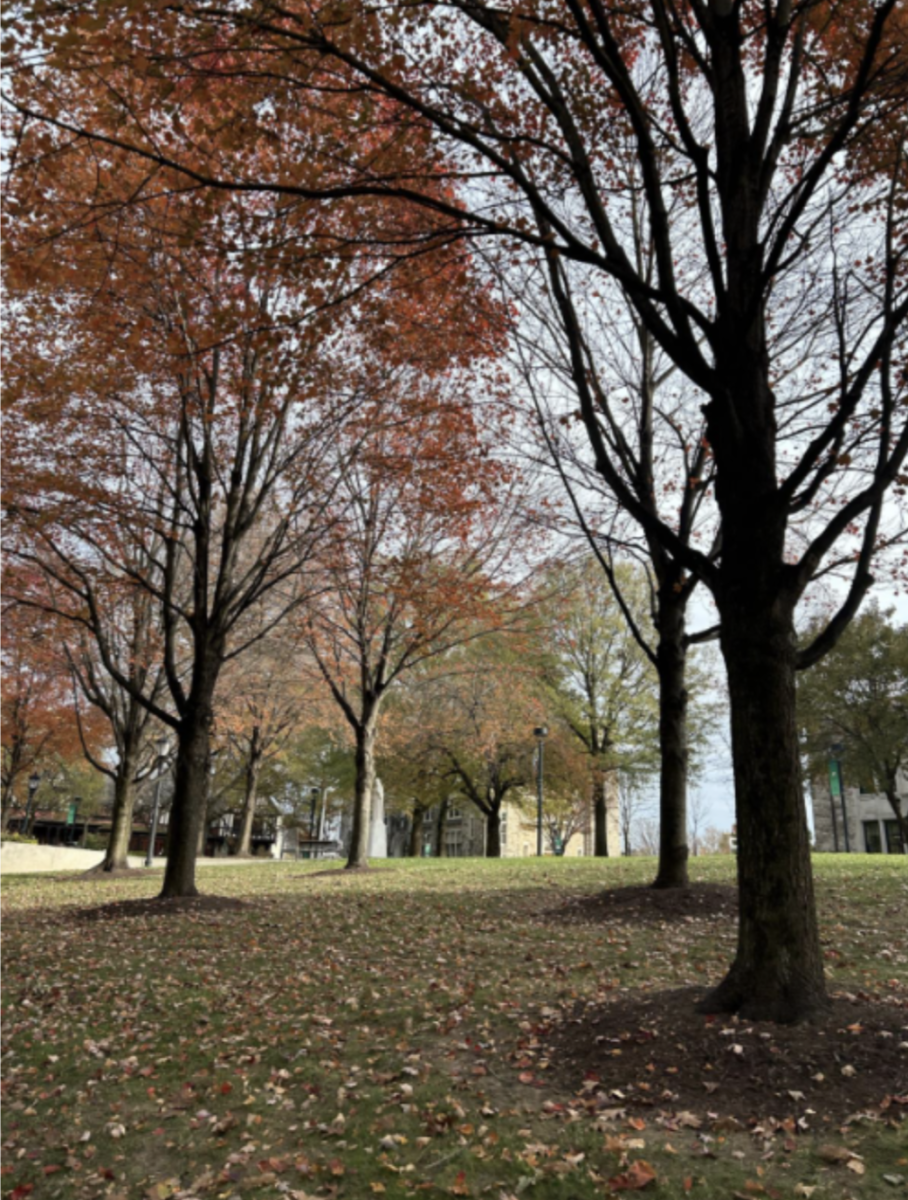
Member of Loyola’s Arboretum Committee and Biology Professor Maren Blohm said the changing colors of leaves are apparent in the start of autumn, but then slowly fade away as winter sweeps in.
“We’ll have some nice oranges and some reds. The gingkos will turn a really brilliant yellow. So, the arboretum is gonna start getting ready for winter, but that’s okay, because it’s natural and we know it’s gonna come back in the spring,” Blohm said.
Blohm explained that this change in color is reflective of the bigger process trees go through to get ready for winter. Chlorophyll is moved from the trees’ leaves to its roots, and the color compounds that are left behind actually act as a ‘sunscreen’ for the leaves.
In addition to changing leaves, the makeup of the arboretum has changed in recent years. Loyola’s Sustainability Committee has implemented various initiatives focused on increasing sustainability.
“We’ve talked more and more about what trees are on campus. We’ve also been a lot more deliberate about talking about what kinds of new plants are on campus. So, around the Fernandez Center, everything that’s planted there is native,” Blohm said.
Blohm said the committee has been pushing for bigger diversity in the arboretum.
Another goal of the arboretum is to increase pollinators on campus, which has already begun with the Peace Meadow located between Stony Run Stream and the Loyola Notre Dame Library. This garden features various native plants that attract pollinators and animals. The committee’s ultimate goal is to get a pollinator corridor through campus to promote greater native species.
Director of Sustainability Office Brigid Gregory said recent arboretum initiatives tie into Loyola’s larger sustainable initiatives, which are part of the university’s most recent strategic plan.
“We are always focusing on investing in more trees, finding better ways to manage the grounds on campus, with regards to being sustainable, whether that means we are adding more no-mow zones, because those are all part of the arboretum when we’re looking at it as a whole. It’s not just the beautiful trees on the quad. It’s looking at our entire grounds as a system,” Gregory said.
As a Jesuit institution, Gregory said promoting sustainability is also comprehensive in the communal aspect, guided by Pope Francis’ 2015 Encyclical and the idea of care for a common home.
“It really aligns the university’s values and connecting our campus community with our broader community by focusing on, you know, not only caring for our environment, but caring for members of our specific community, and then members of the broader community on York Road and Baltimore. By focusing on sustainability, we are able to care for the environment but also look at things from a justice perspective,” Gregory said.
To learn more, scan the QR codes located on the map outside the Humanities Building for self-guided arboretum tours or catch one of the two in-person arboretum tours that will be offered in April 2026. Tours are open to Loyola students, faculty, staff, and all community members.