





































































For the past two years, Loyola’s Athletics has integrated several marketing strategies to boost student engagement. Giveaways, like t-shirts, rally towels, and plushies, seem to be the main pull for students, particularly at women’s events.
The allure of free merchandise is no secret, and Loyola Athletics and the Hounds Activities and Programming Board (HAP) are using it to their advantage to increase student support and school spirit. However, the pattern remains, with students receiving free items and leaving, revealing how transactional the relationship between students and athletics has become. Wanting free merchandise is by no means a crime, but is it too much to ask students to stay for the game?
To combat the issue, HAP has begun to require attendance at least through the first half of a game to receive the item, using tickets to enforce the rule. HAP Board member Megan Young ‘26 said this new ticketing system has worked in their favor.
“You have all these kids already there and into the game, so now they want to see the outcome, versus just coming in, grabbing the giveaway, and going,” she said.
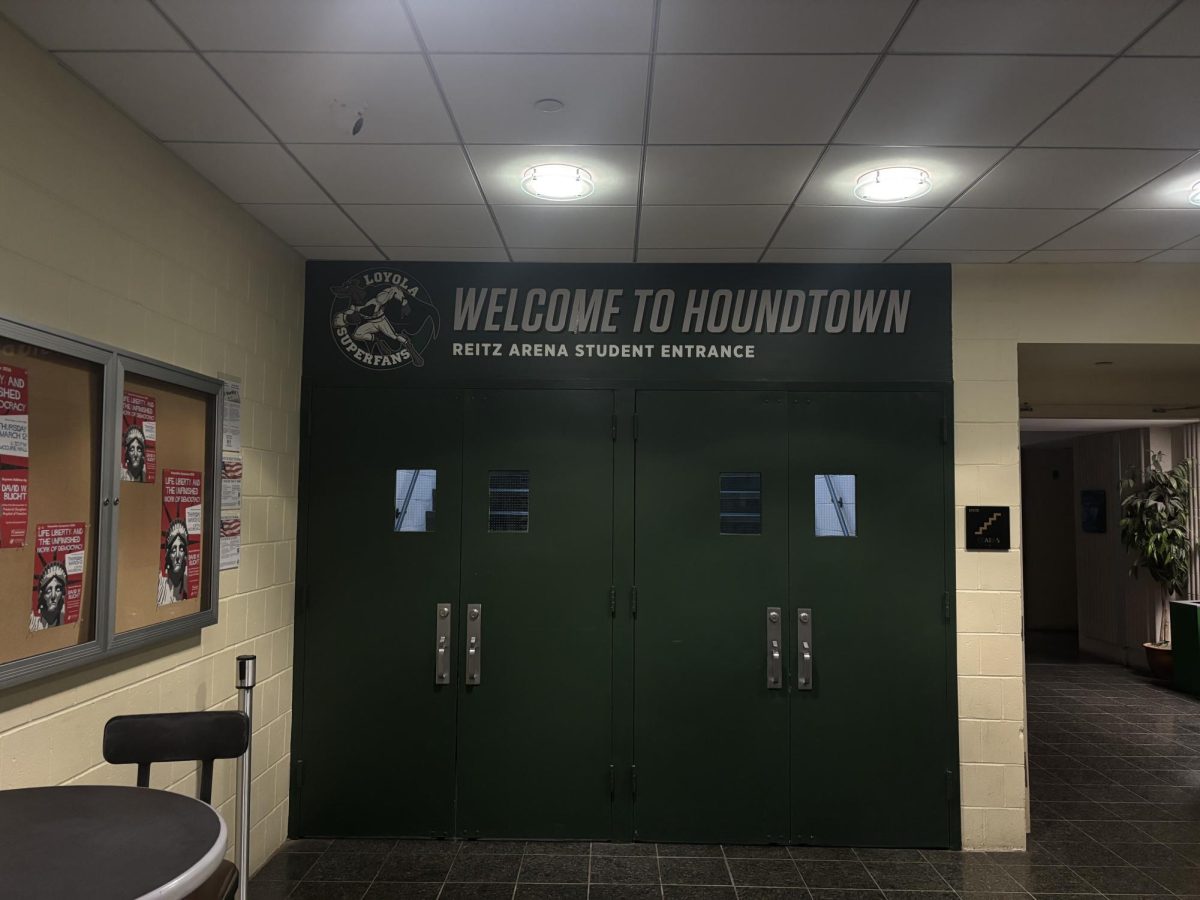
Young believes that the decrease in student connection to athletics could be due to the shift in student engagement organizations, after the leadership program ‘SuperFans’ was absorbed into Hounds Activities and Programming Board in 2023.
Since then, Athletics introduced several contests during the basketball games, such as half-time rounds of tic-tac-toe, and a season-long point system for attendance, giving students the opportunity to win cash prizes, or even tickets to the Final Four. Phil Wrye, Associate Director of Game day Marketing, said he hopes these promotions help bridge this gap in attendance.
Wrye also discussed how themed games, such as the ‘Wizarding Night’ and ‘Stars Wars Day’, has helped increase attendance and participation throughout athletics events.
“The students are really what make these events. The ones that are coming out, making some noise, getting up, cheering and chanting. Making them a part of the event is really what we do,” he said.
Wrye states that while Loyola Athletics is putting in the work to draw and engage crowds, there is only so they can do. At some point, it becomes up to us.
“We want more students to take that kind of initiative,” Wrye said.
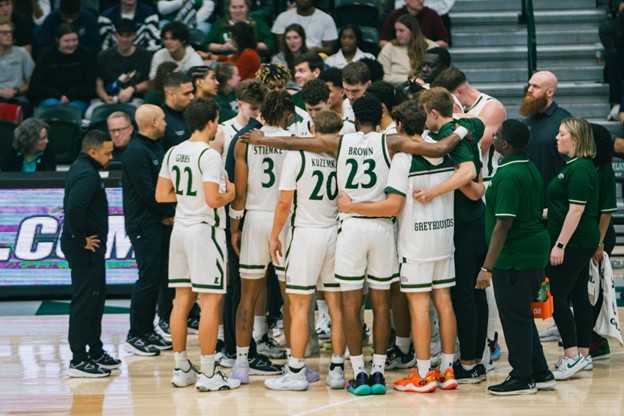
Over the past few years, Loyola has held a few giveaways featuring the phrase ‘Loyola Watches Women’s Sports,’ however, discrepancies in attendance numbers continue to plague our women’s teams. The average attendance for a men’s basketball home game (about 788 people) is often over double that of a women’s basketball home game (about 345 people). The problem persists beyond giveaways and events, as attendance for men’s games is consistently better outside of promotions, with an average attendance of 694 people at non-giveaway games, compared to the average of 245 people at women’s non-giveaway games.
Our status as a small liberal arts school may explain poor attendance, but, given the increased student support for men’s teams, there seems to be another underlying issue. With nearly identical overall records for the men’s and women’s teams, winning does not appear to make a difference in attendance. In fact, the Women’s Basketball Team significantly improved their record from the 2024-2025 season, yet there was a 29% decrease in average attendance this year. So, why are students showing up for the men, but not the women?
Kiana Frawley ‘26, a member of Loyola Women’s Club Basketball team, attributes the disparity to a lack of buzz surrounding the women’s team, as women’s sports have historically gone under-recognized.
“Men’s games tend to have bigger crowds, more word-of-mouth promotion, and more established traditions, which keeps drawing people in. Women’s games don’t always get that same momentum even though the level of play and competitiveness is just as strong,” said Frawley.
As of the 2024-2025 school year, 56% of Loyola’s 3,881 undergraduate students are women. That is approximately 2,173 women, more than Reitz Arena’s 2,100-person capacity, meaning if just half of these students were to attend a women’s basketball game, we could fill the entire student section.
So, let’s pick a date, show up, and make some noise. No excuses. Don’t just come for the gift, stay for the game.