































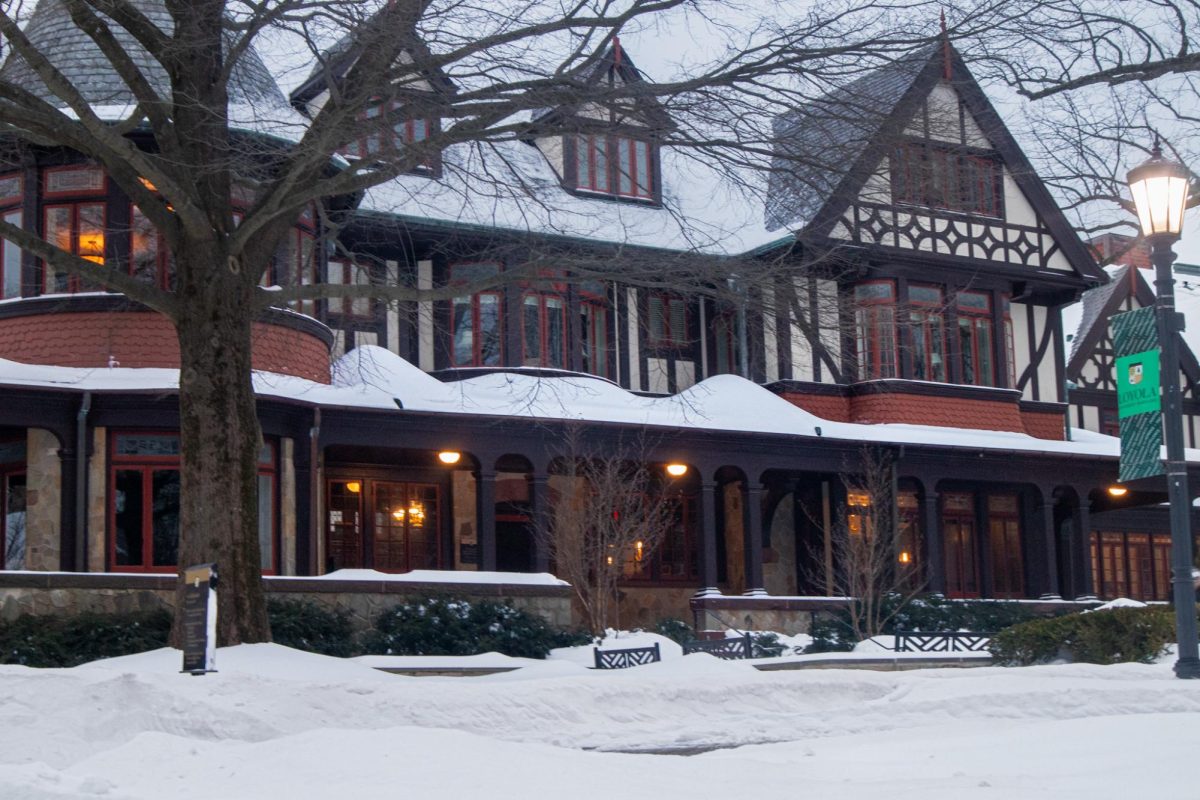




























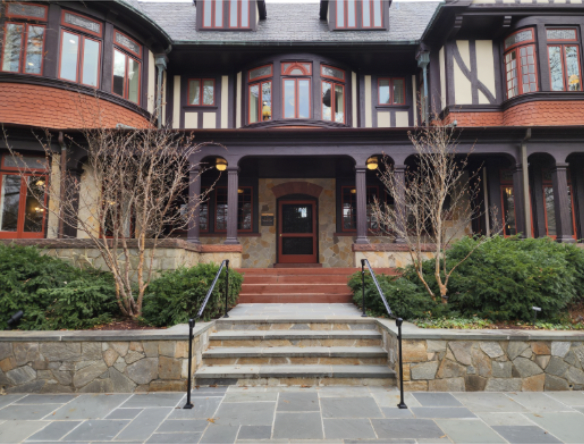
The trees sway back and forth, sending a quiet swishing noise across the quad. Many beautiful buildings, old and new, line the quad’s edges. It is almost impossible to ignore the haunted look of Loyola’s centerpiece building when crossing the quad. The Knott Humanities Center, built in 1896, with its creaky stairs, winding hallways and dimly lit common areas, is the oldest building on Loyola’s campus. What do those centuries of existence hold? The answer, apparently, could be ghosts.
The Humanities building has been many things over the centuries, which may be in part why so many people believe it to be haunted. When it was commissioned to be built in 1896 by Alice Garrett, it was meant to be a gift for her son, Horatio Garrett and his new wife, but Horatio Garrett died before the home could be completed.
“The story is that his spirit wanders around in that part, the east wing, of the building,” said Frank Cunningham, professor emeritus of philosophy and former associate provost at Loyola.
During World War I, the Red Cross used the building to house blind veterans, and it later became home to the Jesuit priests that worked at the University and remained as such for 68 years. There was also a large fire at the building in 1955, in which 12 firefighters were injured. Overall, the building has truly seen so many lives; one might wonder if it has seen just as many deaths.
That history can be quite intriguing to students. Christopher Fletcher ‘26, said that he and his friends have visited the building late at night a few times, specifically to ghost hunt, but never encountered any paranormal activity.
Shateeka Dallas ‘26 said that she feels like the building is definitely spooky. “It just has an ominous feeling to it. The building itself just creates that feeling of eeriness,” Dallas said.
Faculty have shown interest in the ghosts as well. Back in October, Jack Owen, the Loyola Notre Dame Outreach & Community Engagement Librarian, organized a campus ghost tour. On the tour, the group read stories from a book written by former public safety officer Sean Kapfhammer. It was self-published in 2016 titled, ‘The Ghosts of Loyola University and the Surrounding Area.’
“We knew this book was in the archives and we thought it could make for a really fun and engaging activity for students…to learn a little bit about all the cool items we have in the archives, and then actually go on a little ghost tour across both campuses,” Owen said.
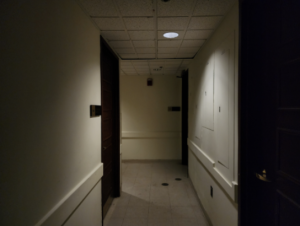
According to Owen, the chapter of Kapfhammer’s book dedicated to the Humanities building is one of the longer ones. The book claims that there were some employees who would not go into the building after dark, but the ones who did often saw paranormal things.
An employee told Kapfhammer that as she was doing her nightly rounds, she saw a full-bodied apparition, dressed in priestly robes. It paused on the middle landing of the steps, then vanished after a moment. The employee described the feeling that washed over her to Kapfhammer as “the feeling you get when your mind is trying to process what you’ve just seen when everything you’ve learned in life tells you that it should not be possible.”
Kapfhammer’s book was published almost 10 years ago now. For such a big, old, haunted building, it seems hard to believe that paranormal activity ceased upon the publishing of a book. Surely, there is someone who has seen something more recently.
But, around every corner of the humanities building seemed to be another office with another apologetic person inside who had never had an encounter with the paranormal.
Most people tried their best to help, recommending the library, or a neighboring department. “We had a problem during Covid where birds kept getting into the building,” Professor Bess Garrett offered. Garrett’s experience was the closest thing to an unusual experience.
The winding hallways soon started to repeat themselves, and the doors already knocked on begin to reappear. After many dead ends, it began to seem apparent that maybe the ghosts of the Humanities building did in fact leave Loyola along with Sean Kapfhammer and his book. Or maybe, they haunted everyone and everything they needed to haunt.
 Regardless of paranormal existence, one thing seems to be at the heart of the Humanities building, and Loyola itself, its history. Owen notes how rich Loyola’s history really is, both in its Jesuit roots and its physical location. He feels it is important for students to engage with it, even if it may be spooky at times.
“Whether we’re learning about that through ghost stories or other channels, it’s important to stay rooted in the history of the school and our location. Whether people are believers in the stories or not, I think it’s a fun, engaging way to learn about our history and to feel a kind of connection, too, with the buildings on campus,” Owen said.
So maybe the next time a stair creaks when there’s no one around, or a door opens, but no one enters, there is something more to it, something larger than just a spooky story to tell in the dark. Something historical, and maybe even beautiful.